Showing posts with label Books. Show all posts

Wednesday, 7 April 2010

Sedgemoor Easter Cakes and Many Good Books


Mary Norwak's Farmhouse Kitchen, which is becoming a book I turn to again and again, has a whole chapter on what she calls Festival Food. The recipes in the chapter include Pately Fritters, eaten in Yorkshire on Ash Wednesday, Creed Wheat and Frumenty, eaten in Wiltshire on Mothering Sunday or in Lincolnshire to celebrate sheep clipping, to Bedfordshire Wigs, traditionally eaten on St Katherine's Day. Today the children and I made Sedgemoor Easter Cakes, using a recipe I adapted from Mary Norwak combined with a HFW recipe first published in the Guardian.
Here's Norwak's recipe, with my adaptions in brackets.
8 oz plain flour (I committed a baking sin and used SR)
4 oz butter
4 oz caster sugar (another baking sin committed, I used granulated)
4 oz currants (yes, I used sulatanas!)
1/2 tsp mixed spice (didn't have any in the cupboard)
1/2 tsp of cinnamon (used 1/4 instead)
1 egg
2 tablespoons of brandy (I used rum!)

Rub the butter into the flour and stir in the sugar, currants, spice and cinnamon. Beat the egg with the brandy and mix with the dry ingredients. Roll out half-an-inch thick, cut into rounds and bake at 305F, 180C, gas mark 4 for twenty minutes.

We cut our biscuits into egg-shaped rounds, just as a bit of Easter fun! Also, we did as HFW advised and glazed them whilst still warm, which makes them quite sweet, but nice looking. It seems to me that traditional regional cookery differs by simple ingredients - the difference between Parkin and Yorkshire Parkin being extra oatmeal here, less ginger there. I suppose the ingredients were what came to hand and many folks improvised, just like I have today. Perhaps I should re-name the cakes Warwickshire Easter Cakes. Anyway, they are very, very moreish and taste like a rich, flat scone or an extra light shortbread, but in a boozy, spicey way. It says on the Guardian site that traditionally they were given away in threes, to symbolise the Trinity, which is a jolly nice baking tradition we seem to have in many parts of Britain.

So onto books. I've read some great books just recently that I really want to recommend before I go back to the world of paid employment. First, Marjory Sharp's The Nutmeg Tree. I bought this book because of fits cover: a lovely piece of 1930s design, not deco, but gloriously womanly and frivolous. And it turns out that you can judge a book by its cover. If you were a fan of Miss Pettigrew Lives for a Day, then you'll love this book - it's both light-hearted and warm-hearted. Marjory Sharp is perhaps more famous for her Rescuers children's books and Cluny Brown, and she deserves to be republished...I should write to Persephone Books, they'd love her.

I've also been reading Georgette Heyer, both the mysteries and the romances. I'm not quite sure what to make of her. The mysteries always rollick along quite nicely until the abrupt and disappointing endings and although the romances are superbly detailed, they are a little over-written and irritatingly snobbish. I am a real fan of 1930s literature and am well aware of how the working classes and "foreign types" were portrayed in many of these books, but Heyer's outright antipathy to the "lower orders" is at best irksome and at worst repulsive. She is very much of her time: her Georgian heroines are flappers and her rakish fops are Bright Young Things: and this is what fascinates me so.

I have returned, yet again, to Elizabeth Taylor. I think she may be the most underrated British novelist of the twentieth century. I've just finished reading A Game of Hide and Seek, it is finely nuanced and she shows remarkable clarity in her characterisation and a generous empathy for the people she creates. A wonderful, sad book about love and highly recommended.

Next up, Barbara Pym's first novel Crampton Hodnett. I like curates, Lions Tea Rooms and Fuller's walnut cakes in my novels. I also like spinsters, romantically thwarted dons and High Church snobbery. I shan't give away anything of the plot of Crampton Hodnett, but suffice to say it is typical early Pym and an absolute joy. Here's an extract.

"Hullo, Mr Latimer, going to take evensong?"
The bright, almost chirpy, tones startled him, and Mr Latimer turned round to see Mrs Wardell standing by the vicarage gate, with a trowel in one hand and a young plant in the other.
"Yes, I am," he said shortly. It was surely obvious that he was going to take evensong. Where else could he be going, with a cassock slung over his arm and a face as long as a fiddle...

When he got to the church he found the usual weekday congregation there. Miss Doggett and Miss Morrow, old Lady Halkin, the Misses Grote, Mrs Allonby, Miss Nollard and Miss Foxe, Mrs Jason-Lomax and Jim Storry, a feeble-minded youth who did odd jobs in the church such as fetching vases and putting up wire frames for the ladies when they did the flowers.

Yes, this was the Church of England, his flock, thought Mr Latimer, a collection of old women, widows and spinsters, and one young man not quite right in the head. These were the people among whom he was destined to spend his life. He hunched his shoulders in his surplice and shivered.


I am hoping there are a fair amount of walnut cakes, curates and spinsters in Mrs Tim of the Regiment. I haven't started it yet, but it looks very good. It's one of those Bloomsbury re-issues, and amongst The Brontes Go to Woolworth's as a bit of a bloggers' favourite. I shall post on it when I next get the time.

Well, you've probably realised that I am now fully rested and well fed and well read and am extremely unlikely to go embarrassing myself in front of Ed Balls (who was that masked woman...?) I hope you all have had a happy and peaceful Easter. Until Anon!

PS. For a Simnel Cake recipe go here and here.
For Hot Cross Buns go here.

Tuesday, 5 January 2010

Bits from Books

( A photograph of my home town centre, taken in the 1950s when my copy of Newnes Household Management was first published)

So I'm sitting here waiting for the snow to come. We've not had the bad weather here in the middle Midlands, but we're due it today and my girls are expecting their schools to close at lunch-time so they can come home and make a snowman on the green. What can I say? They're an optimistic pair. I've been watching the chaos the bad weather has been causing in other parts of the UK with interest. Apparently, there's a poor woman in Scotland who left her home on 23rd December to buy a turkey for Christmas and is still stuck in town, unable to get back to her cottage, her husband and their six dogs. And the bad weather brings me, in a very roundabout way, on to some bits from books; bits from books I had for Christmas, in fact.

I remember one time, just after one Christmas in the late 1980s we has such bad snow that our water pipes froze and we had long power cuts. Roads were pretty impassible for a few days, but we had a house full of Christmas left-overs and we melted snow on the gas hob for water...believe it or not, we had a lot of fun! I completely forgot about this until my sister gave me Jocasta Innes Country Kitchen as a Christmas present this year, and my mum said "can you remember making the syllabub from that book when we had all that snow?" It all came flooding back, I was about fifteen or so and the syllabub is one of the first recipes I followed from a book. I've never looked back. Here's the recipe.

Good cows they were and never ailed, and plenty of everything there was in that house, good milk and cheese and buckets and buckets of skim for the pigs.
Precious Bane, Mary Webb.

Syllabub
1 lemon
1 small glass (4 fl oz approx) Marsala, Madeira or sweet sherry
2 tablespoons castor sugar
1/2 pint double cream
pinch of ground nutmeg
Grate the lemon rind, squeeze the juice and combine both with the sherry and the sugar. Leave to stand for a few hours, or overnight. Strain (to remove the rind) and add to the cream. Then whisk till thick, fluffy but not too stiff. Spoon into little glasses and serve cold with biscuits.
*******
Well, the snow is falling now. And I quite fancy some rich, snowy-white syllabub to fortify me against the vagaries of the weather. Actually, I can't help but think that syllabub would make a great rich topping for a trifle. I am incorrigible.

Next up, we have two volumes of Alison Barnes' Newnes Household Management from the 1950s. These were a present from the DH and I love them. They offer a complete and comprehensive journey into the 1950s housekeeping ideal, and have a lovely idealistic and business-like tone. Volume one alone includes advice on: pressure cooking; tea party food; getting your figure back to normal after having a baby; how to lay out a herbaceous border and the ABC of dressmaking. But first, I offer you an extract from the foreword.

Home is the most important place in the world. It may be a bachelor bed-sitting room, a rather poky little flat, a part of someone else's house, an inconvenient cottage or a rambling barn of a place. Whatever it is, making it into a home brings its own unique brand of personal satisfaction.

A good home is a well-organised one and produces happy, well-balanced, tolerant human beings, able to give and take. It is in the badly managed homes that you find constant quarrelling, strain, distrust, emotional tension and spoilt, undisciplined children destined, if their parents only realised it, for untold unhappiness when they get out into the world and can no longer have their own way. For a child's earliest experience of adapting itself to others - and so into the pattern of a civilised community - begins in the home. Without the right home atmosphere, no child can ever really learn the true art of living.

Personal happiness and national welfare therefore depend very largely upon sound home management, which is the joint responsibility of all who live in the home.

Here let me add a word of warning: the house that runs as smoothly as well-oiled machinery (and just as soullessly) must never be confused with a real home that has a warm, friendly atmosphere because it is built on a sure foundation of affection and understanding.

Has never a truer word been written, gentle reader?

But now onto volume two, which offers the homemaker instructions on: etiquette; how to make a Christmas centre piece; traditional Jewish food and how to deal with dry rot. However, I shall leave you with their chapter on Elizabethan recipes. There was quite a fad for the Virgin Queen in the 1950s, they were, after all, the new Elizabethans! Here's what Alison Barnes has to say on the matter.

Authentic traditional fare from the days of Good Queen Bess, as served in the Elizabethan Room at the Gore Hotel, London.
Syllabub
Take a pint of canary or white wine, a pint of raspberry juice, a sprig of rosemary, a nutmeg quartered, the juice of a lemon, and some peel with sugar, put these together in a pot all night and cover them. In the morning take a pint and a half of cream, and a pint and a half of new milk. Then take out the lemon peel, rosemary and nutmeg, and squirt your milk and cream into the pot. With a wooden cow, fold at the corners. (The nearest modern equivalent of a wooden cow is a grooved wooden butter par, but this part of the recipe can be omitted without damage to the resulting dish.)

Never mind finding a wooden cow, how in the heck do I squirt the milk and cream? The mind boggles. I imagine Jocasta Innes reading this recipe sometime in 1955 and thirty years later finally coming up with a workable syllabub and punching the air in satisfation. On that note I must anon goode huswives! I shall see you in the mid-term break!

Tuesday, 23 June 2009

Symphony of Sorrowful Songs, Blaming, Miss Read, Advice


I hope you enjoyed this beautiful piece of music by Gorecki. Sometimes it's good to feel the strong emotions music and art promote, perhaps because we can feel a oneness with our fellow man when emotion is shared in such a way, perhaps great artists have the knack for expressing what we cannot?

I just thought that I would give you an update on my father in law. He is doing a little better, his pain comes and goes, but it is manageable. I want to thank you all for your kind prayers and thoughts, I truly believe they have helped us, and my father in law, get through some difficult times.

For all of you bookish types out there, I thought I'd share some recommendations. First, Blaming by Elizabeth Taylor (no, not that one!). A strange, clever novel, whose main character is so intensely human the reader's sympathy with her shifts on a constant basis. I think Taylor understands that people's inner narrative is often not as generous as their outward actions, I know this is true of me, therefore I found the book to be rather real, and often quite touching. Oh, and here is a link to a Guardian article about her work and a recent biography.


Secondly, I've been eating up the Miss Read Fairacre novels. The literary equivalent of gobbling buttered toast simply to comfort oneself. Considering my proclivities towards country living, happy childhoods and well stocked pantries I've come rather late to Miss Read, however what a joy it's been to read them!


Now, here's a poem for all you Pooh Bears to philosophise over.


Advice

When you are faced with two alternatives

Choose both. And should they put you to the test,

Tick every box. Nothing is ever single.

A seed's a tree's a ship's a constellation.

Nail your true colours to this branching mast.

Robert Crawford


Well, anon gentle reader, I hope to see you soon!

Tuesday, 5 May 2009

Bits from Books

Generally when I do my "bits from books" posts I concentrate on my homemaking books, but today I thought you might like a change and look at some vintage children's literature. Both the DH, myself and our eldest girl love to collect children's books: the DH likes the Andrew Lang fairy books; our eldest spends her birthday money on first editions Famous Fives and Malory Towers; and, well, the little one just likes to look at the pictures in pretty much any book! Other than the DH's Andrew Lang books (what can I say? he's a man of taste and discernment) we pick up these books for less than a fiver. My eldest has found one or two vintage Blytons for pennies, which is great for her as they often cost her quite a bit when she buys from eBay. Anyway, I digress. Here are just a few choice morsels from the family bookshelf! First up, is Enid Blyton's Book of the Year. It's a War Economy book, and published at a time when children's books were rare and quite expensive. War Economy books often have monochrome covers, black and white illustrations and poor-ish paper quality, but nevertheless they're often really great in content, and like all vintage things offer us a precious insight into a world gone by. The book is a fun mixture of nature notes, plays to perform, short stories, non-fiction and poetry. It's aimed at a readership of 10-12 year olds. Here's an extract.
Three Mottos for the New Year
Choose one of them, print it and colour it.
1. "Many men can do a wise thing; many more can do a cunning thing; but very few can do a generous thing."
(We'll be one of the few then, boys and girls!)
2. "'Tis a lucky day, boy, and we'll do good deeds on it!"
(We'll call every day lucky, shall we!)
3. Do all the good you can,
To all the people you can,
In all the ways you can,
As long as ever you can!
(We shall be kept busy if we choose this motto, shan't we!)
It's easy to dismiss this stuff as prissy moralising, just the kind of thing children are not interested in. However, I believe that children have an immense capacity, and need, to do good and be good. They find the shaping of their character to be an exciting and interesting thing. We let them down by by framing their moral teaching in relativistic terms, something to be discussed and analysed rather than taught, this kind of morality comes for later years. Let's just teach them what is right and what is wrong, and allow them the pleasure of consistency and routine in their complex little lives.
Next up, is Warne's Picture and Reading Book. Those amongst you who are wed to the synthetic phonics way of teaching reading, would get a real kick out of this. The illustrations are wonderful and so "of their time" that it makes you want to long for those between the wars years of ponies, tea parties, berry picking...and rickets! The reading primers, however, are a little disconcerting to this modern mummy: all nonsense words and cvc rhyming. I tried it out with Freya (my youngest) who rather likes Kipper and Biff, but she was bored stupid by this book and wondered why the story didn't go with the pictures. But oh, what pictures!


Here's one for the boys. Oh, what larks you chaps had at school, it makes one rather jealous! Quite frankly this book is so packed full of testosterone that it's actually growing stubble. It's a budget book, so the illustrations are black and white, but the stories are spiffy. Here's an extract from Pulling his Leg! by Capt. F.V. Hughes-Hallett, D.S.O...it seems to me that young boys of the 1920s were obsessed with having adventures in Canada...oh, Canada!

Somehow I think that hook of yours must have got jammed in the bear's jaw! But the was certainly having a rare game with me, and if I had taken much longer to make myself intelligible to you in my frenzy, goodness knows what the end of this here child would have been!


And, finally, let's leave the best until last. The Mystery of Coveside House, is a treasure of a book. Filled with the kind of sun-kissed, athletic girls John Betjeman would've gone nuts over, and steady, brave young men who made the Empire great. In it, Daphne and her friends Anthea, Bob, Mary and Tony investigate aforementioned mysterious happenings with youthful vigour and without any sense of irony! Fabulous. Here are the opening lines.

"Anthea" said Daphne, as they walked home from school together. "If you're not doing anything tonight would you come down and help me with that beastly trig? We'll go for a bathe afterwards," She added as an inducement.


The fact that poor old Daphne has to wrestle with that beastly trig, puts this book firmly in the post-war era, when girls' schooling began to resemble the more universal education of boys; hard maths and games being taught alongside French and dainty sewing. I think we forget too easily the advances we've made in eduction over the past one hundred years in Britain. We should thank our lucky stars for this gift. Really we should.

Well I hoped you enjoyed this peek into the family collection. It was nice to share it all with you.
Anon, bookish huswives, anon!
NB: I have edited this post and corrected my errors. Note to self, must proof read!

Wednesday, 15 April 2009

101 Things to do with a Stale Hot Cross Bun

You must forgive the somewhat grandiose title of this post, gentle reader, as really I am only giving you an idea for one thing to do with stale hot cross buns, but I know that you are all women of considerable ingenuity and imagination so I hope I get some suggestions for the other 100 things you can do with a stale bun after Good Friday!
For my own part I give you Hot Cross Bun Pudding. This is a recipe I've adapted from my Elizabeth Craig Cookery Illustrated, a 1930s tome which can be picked up quite easily for less than a fiver. For those interested in what the average Joe(anne) ate way back when you can't go far wrong than to read this book, and the illustrations feature lovely deco tea trays and table settings, all in all, a jolly nice buy. Anyway, on with the grub. Here's the recipe, and I apologise for my crummy photography.

Hot Cross Bun Pudding
4-6 hot cross buns (stale), quartered and buttered generously
1 pint milk
1/2 pint single cream
grated rind of an orange
2 oz sugar
3 eggs, well beaten

Butter a large casserole or pie dish. Place quartered, butter buns in dish so that they overlap with each other ever so slightly. Sprinkle each layer with a little of the sugar until you use up the 2 oz. Mix the milk with the cream and then add the beaten eggs, and mix well. Pour on top of the buttered, sugared buns and leave for at least 15 minutes until the mixtures has been absorbed. Bake in a low oven (in a bain marie if inclined) until the custard is set, this will take between 40 and 60 minutes. If it looks palid when you take it from the oven, sprinkle a little sugar on the top and put under a hot grill for a few minutes until browned. Serve with clotted cream (I mean it)!

Oh, here are a few Hot Cross Bun facts, with which you may astound your friends and family!
  • Before the Reformation many baked goods carried the sign of the cross. Hot Cross Buns are the sole culinary survivors of this ancient tradition.
  • Many country women would bake buns and bread on Good Friday because they believed their baking would contain miraculous powers of healing. They would hang them in the rafters of their kitchens and give to those who were ailing.
  • In 1987 I won a Hot Cross Bun eating competition, downing 8 in 15 minutes. ( This last one is a fib, but I had you going for a minute)!
Well, if you do use up your stale holy day buns in this way, please let me know if you enjoyed the pudding. Anon, fellow huswives, anon!

Wednesday, 18 March 2009

Bits from Books

Reading Woman, circa 1900 by Pierre-Auguste Renoir
Reading Woman, circa 1900
I want to thank you for all of your "get well soons" in the previous post. Thankfully, the mystery rash turned out not to be chicken pox or shingles, but a strange allergic reaction to I know not what. I'm pretty much back to normal now, although still a little tired and swollen (on my extremities!), and I hope to be back in blog action from now on. I've been doing quite a bit of reading over the past week, but feel a little too lazy to write a proper book review (I'm like a hungover university student at the moment) so I thought I'd find you a few choice quotes and give you a little overview of each book I've read (re-read). Enjoy, bookish huswyfes!
Cold Comfort Farm
I'm not a big fan of Thomas Hardy, or DH Lawrence for that matter. All of those rural drama-queens fighting and fornicating get right on my pip. I want to walk right into the novel and boss them all about, teach them a few lessons on counting their blessings and introduce the main protagonists to nice boys and girls who will treat them well and keep the cottage garden neat and tidy. I can't help but think that Stella Gibbons felt the same, and that is why she invented monumental bossy-boots Flora Poste. To cut a long story short, armed only with a delightful and suitable wardrobe and her favourite book, The Higher Common Sense, Flora moves in with her disastrous rural cousins the Starkadders and tidies up their lives. It's a jolly good read, a well achieved satire and often laugh out loud funny. I enjoyed it very much, and you will too if you have a slight bossy streak. Here's an extract.
"By the way, I adore my bedroom, but do you think I could have the curtains washed? I believe they are red; and I should so like to make sure."
Judith sunk into reverie.
"Curtains? she asked, vacantly, lifting her magnificent head. "Child, child, it is many years since such trifles broke across my web of solitude."
On Green Dolphin Street
I'm quite a fan of Sebastian Faulks. He has a knack for writing about love, and how women love, in such a real and sympathetic manner. His prose is absolutely beautiful and he's not a bit tricky or self-satisfied. When I'd finished this novel I wanted to hug him, just for being such a very good writer. I suppose the subject matter of the novel is a little tricky though, particularly if you're a Christian, as it concerns a woman's deep and loyal love for her husband and children and the passionate love she develops for another man. Faulks is neither judgmental about the woman's choices nor does he justify them, but simply describes the woman's relationships with tenderness and honesty. For a long time the affair she embarks on is reminiscent to that in Brief Encounter, however, towards the end of the novel, her relationship with Frank is consummated, and Faulks' prose gets a little, well, saucy. I found it very moving. Here's an extract from the beginning of their romance.
She said, "I want you to know for today, tomorrow, for the rest of your life how much you have meant to me, how much you have touched me with your ..." she smiled, feeling tears pricking at her eyes "...your tour of the city. I want you to remember always what a fine man you are, or so you seem to me. I so much admire your dedication, how much you've done, how hard you've fought for yourself. And your kindness, your manners, your...Well, everything about you. I think you're wonderful. Wonderful."
Frank sat staring at her for a few moments. He looked now exactly as he had on the first night she had met him, after the party, black marks beneath his eyes, his tie half mast, his cropped hair slightly rumpled.
He said, "Have you finished?"
She bit her lip and nodded.
He said, "I'm in love with you too."
The Pace of a Hen
The Pace of a Hen is the best book I've read on Christian homemaking, this is because the writer sees the homemaker's role one of providing stability, support and sound teaching. She uses the shape of the cross to teach women how to lead a truly balanced Christian life and pass this sense of balance onto our husbands and children and the wider community. She believes that a Christian's life should compromise prayer, recreation, work and family and I think this idea of leading a truly harmonious life for Christ is incredibly pertinent in today's world, where the work/life balance is so skewed in favour of work that many of our families become fragmented, dysfunctional and just plain old tired out. There is so much great advice in this book, that I'm a little spoilt for choice in choosing an extract, but here's what Josephine Moffett Benton has to say about creativity.
The results of creativity need not always have visible shape and design. The main field of creativity in our day, Fritz Kunkel once said, should be human relationships. Listening to a neighbour can create friendship; listening to a bird can create worship; listening to God can create a soul.
Our minds need many kinds of exercise, and creativity which uses mind and muscles is a source of balance and a wellspring of joy. A woman who walks in the woods, who makes a lampshade, who bakes a loaf of bread, who refinishes an old chair, has not time for bitterness and depression.

Thursday, 5 February 2009

Notes and Queries, Hidden Art, and the Give-Away Announcement

Well, I want to thank you all for the nice comments you left in my previous post, they were all very much appreciated. However, without further ado I shall announce the winner of the book, magazine and dishcloth...drum roll please...it's Angela! I know that Angela is a very creative person, so I think she'll really enjoy "Hidden Art." It's a great book, and not just for homemakers I think, all about how Christians can bring beauty and artistry into their every day lives all for the glory of God, something which I think we modern Christians tend not to do, but I believe is of real importance.


Home Chat is a bit of Edwardian fun, a penny magazine, aimed at the women of the lower middle classes and full of interesting tips and remarkable advertisements...those poor Edwardians seem to be horribly (ahem) "bunged up"...probably due to over-consumption of suet pudding!


Next up is this knitted dishcloth. I used the Quaker Ridge pattern as featured on the Mommy Cooks blog (a great blog, still online but no longer updated)...my cloth turned out rather differently to hers, but nevertheless I still like the pattern!


So now on to the Notes and Queries section of the post!


Seraphim, now joyously untormented by those of us who leave it to the last minute to post our tax returns, wanted to know about knitted dishcloths. I'm pretty passionate about knitted dishcloths (I know, what a thing to be passionate about). They're eco-friendly, frugal, last forever, ethical, a good way of practising new stitches, a great beginner's project and more importantly they're rather pretty. Anything which glamorizes the washing-up is okay in my book, and they follow that great tradition Christian women of yore had of making everyday items beautiful. There's a great online resource for dishcloth patterns, that you'll find here, or you can make your own pattern and experiment! In the UK you can by dishcloth yarn, quite cheaply in most craft shops, but you may have to go to big cities to find the nice self-striping colours you find used on American cloths.


Next up, Niki from Rural Writings asked for a recipe for a classic Victoria Sponge, but converted into US/Can cup measures. I'm really glad she asked the question as it's something I've been discussing on Nan's Letters from a Hill Farm blog. Most British women know the recipe well because it follows a specific pattern of ounces. So for a small, 6 inch, cake, you'll need 4 oz of butter, 4 oz self-raising flour, 4 oz of sugar and 2 eggs. For a larger cake the pattern is all the 6s and 3 eggs, for a big cake all the 8s and 4 eggs.


But the trouble with converting this into cup measure is that a cup of flour and a cup of sugar do not weigh the same, so if you put the measurements into one of those online cooks' measurement converters it comes up with all sorts of unmanageable decimals. Another problem with this kind of conversion is that the way flour works in different countries is not standardised. What rises in the UK, may not rise in Canada, may not rise in the USA. So what I've done is email Niki with a Nigella Lawson recipe which has been specifically written for the American market. I trust Nigella, her How to Be a Domestic Goddess book is an excellent bakers resource and she's really well read on her subject, so I reckon this cake is a pretty decent approximation of the English classic. Also, have a looks at Nan's blog about Laurie Colwin, the book sounds wonderful, so I imagine the cake recipe featured is pretty good too.
Edit: have now proof-read this post, I hang my head in shame, thank you for putting up with all of those errors!
Edit Number Two!!! Here's Erin's recipe for an American Victoria Sponge
1/2 cup soft margarine
1/2 cup sugar
2 eggs(1 tsp vanilla extract)
1 cup self-raising flour
As four ounces of flour is one cup, but four ounces of sugar is a 1/2 cup.

Wednesday, 3 December 2008

The DH: International Man of Mystery ...and Other Sundry Subjects

I've been feeling a little guilty about blogging just recently. It's been a busy time and although I've done blogabble things and thought bloggable thoughts I can't just seem to get any of these things and thoughts down in html format. I haven't been around my friend's blogs as much as I would've liked either, for which I apologise. However, things should be back to normal after Christmas, when the cooking and the crafting and the social whirl of advent and Christmas are over. I always want so desperately to separate advent from "the run up to Christmas" that I tend to get the secular stuff over and done with in November, hence the blogging lull. But, it's still a busy time of year for us: my youngest seems to have been invited to a classmate's birthday party every weekend for the past three weeks; it's her birthday on 20th December; she's in two Nativity plays; the eldest has mock exams; is caroling like crazy; and is involved with two special school/church services over advent; and to top it all the DH will be on a business trip for 5(it was just 3)days just before he finishes for the Christmas break!

He's off to Sweden. I don't know what he's doing there. When I asked him he said "oh just meetings, training and stuff." Actually, I was asked what my husband did for a living the other day at one of the numerous kiddy parties I've been attending over the past few weeks. I had to admit that I didn't really know, which is a shame considering that I know that my youngest's best friend's dad works in computer support at a large car manufacturer, my eldest girl's best friend's dad works as an engineer for yet another posh car manufacturer, the bloke next door took early retirement from Peugeot, the bloke over the road is a quantity surveyor, the bloke next door but one is a police officer...however, what the DH does for a living is a complete mystery to me. Don't get me wrong, I know where he works, I *think* I know his job title (but it tends to change), I *think* he works in contract law and finance (straddling two departments, perhaps?), but that is it. It's all I know. It's not that I'm not interested, I hope I show proper wifely concern about his work, it's just that the DH has this uncanny ability to shrug off his work-life as he comes through the door of an evening. His home-life and his work-life are two entirely separate fields and the twain will never meet. It's the way he wants it, and I'm happy with that, although this attitude did take some getting used to as my father lived and breathed his work, it was his life and his obsession.

My own mother is so taken aback by the DH's reticence about his work-life that she swears he works for the secret service. However, seeing as the DH has not made love to any Russian spies in a space station or thwarted any shark-owning, cat-loving, crazy plutocrats just recently I think she's a bit off the mark. Needless to say, if Sweden hits the news just before Christmas because of a giant, violent brawl on a moving train involving a man with metal teeth, a beautiful blonde, and a suave (yet strangely thuggish) man with an English accent, you know she's right.

Anyway, whilst he's away a) doing "meetings, training and stuff" or b) saving Queen and Country from certain doom I shall be consoling myself with cheese and onion crisps, good books and my Fred and Ginger box set. Quelle Joi! Here's an extract of them doing their thing. I defy you not to smile and look on in wonder. I'm going to wear a dress just like Ginger's on Christmas day...or I may just wear my jeans, I dunno.


Oh, and talking of good books. The delightful homemaker, rabble- rouser and internationally famous southpaw, Frances has asked me to join in with a book meme. I have to turn to page 56 of the nearest book to me and type out what it says. Now, I've just finished tutoring a home-schooled pupil of mine and we've been reading To Kill a Mockingbird. My pupil is a good boy, and is really engaged with the text...but what a text it is!! Here's page 56 for your delectation.

We leaped over the low wall that separated Miss Rachel's yard from our driveway. Jem whistled bob-white and Dill answered in the darkness.
'Not a breath blowing,' said Jem. 'Looka yonder.'
He pointed to the east. A gigantic moon was rising behind Miss Maudie's pecan trees. 'That makes it seem hotter,'he said.
'Cross in it tonight?' asked Dill, not looking up. He was constructing a cigarette from newspaper and string.
'No, just the lady. Don't light that thing, Dill, you'll stink up the whole end of town.'
There was a lady in the moon in Maycomb. She sat a a dresser combing her hair.

I do love classic American fiction. I loved Fitzgerald, Whitman, Harper Lee way before I began to love George Eliot and Auden. American prose is less weighted with literary expectation, less painfully mindful of history. American authors created the modern literary style, in my opinion, as they were neither encumbered by tradition, or trying to shrug it off (why are British early twentieth century modernists so bloody unreadable, yet Faulkner and Fitzgerald so compelling?). Well, before this post rambles on into infinity, let me just tell you that I've been reading Willa Cather. I've just finished O Pioneers!. Good grief, what a brilliant book. I can't help but think my friend Jody would love it. In fact everybody will love it. There you have it. Post finished. Brain now empty! Happy advent, gentle reader!

Friday, 28 November 2008

The Famous Five Eat a Big Tea!

Now, I could write a long post saying why I think Enid Blyton is such a good children's writer. But I won't. I will say however, that she is one of the very few authors that children turn to voluntarily (and without parental pressure) to read over and over again. I know the old girl churned them out, and the quality of her writing is a bit suspect, and she didn't care for foreign types, and so on and so on. But children get a great deal of pleasure from reading her work, and this, I think, is the way to create a successful reader...give 'em a book they'll enjoy! Anyway, my eldest came to me last night and said she'd marked the page of a book she'd been reading because she thought the readers of this blog would like it. I do like it, perhaps you will too!

They came to Great Giddings at about ten past five. Although it was called Great is was really very small. There was a little tea-place that said 'Home-made cakes and jams', so they went in there for tea.

The woman who kept it was a plump, cheerful soul, fond of children. She guessed she would make very little out of the tea she served to five healthy children - but that didn't matter! She set to work to cut three big plates of well-buttered slices of bread, put out apricot jam, raspberry, and strawberry, and a selection of home-made buns that made the children's mouths water.

She knew Richard quite well, because he had sometimes been to her cottage with his aunt.

'I suppose you'll be going to stay with her tonight?' she said to Richard, and he nodded, his mouth full of ginger cake. It was a lovely tea. Anne felt as if she wouldn't be able to eat any supper at all that night! Even Timmy seemed to have satisfied his enormous appetite.

'I think we ought to pay double price for our gorgeous tea,' said Julian, but the woman wouldn't hear of it. No, no - it was lovely to see them all enjoying her cakes; she didn't want double price!

'Some people are so awfully nice and generous,' said Anne, as they mounted their bicycles to ride off again. 'You just can't help liking them. I hope I can cook like that when I grow up.'

'If you do, Julian and I will always live with you and not dream of getting married!' said Dick, promptly they all laughed.

Now, I'm a plump woman, who being fond of children, likes to see them enjoy eating the cakes I bake. So I better get cracking, clean this mess of a house, and pop a cake in the oven! But before I go here is a link to another online Enid Blyton Society and a link to a Radio 4 programme about her writing. Enjoy!

Wednesday, 12 November 2008

Posh Food

A while ago I read an article, in a 1930s edition of Good Housekeeping Magazine, by Florence White. Florence White was Britain's first professional food writer and her most famous book (and indeed one of my favourite cookbooks) Good Things in England, which was first published by the English Folk Cookery Association, is now reprinted by Persephone Books. Anyway, in this article Florence White interviews the servants of the great and the good of 1930s Britain to find out what kind of food the rulers of the Empire liked to eat. She found that there was a resounding inclination towards simple, good food; plain English cookery well made from excellent local produce and nicely cooked. Prime Ministers, Lords, Bishops, MPs and captains of industry all preferred roast beef, steak, chops, roast potatoes, a good vegetables to any Escoffier-like confection. At tea they enjoyed ham sandwiches, plain fruit cake and good quality tea, they eschewed the fancy. She came to the conclusion that they enjoyed this kind of food because they were brought up on vast, self-sufficient country estates, where the food was plain because it was the very best and needed no cream sauce or aspic to make it any better.

Interestingly, Maria Floris, in her wonderfully comprehensive book on baking,
Bakery, states that when she provided the baked goods for 10 Downing Street, Winston Churchill's secretary told her that his favourite pastry was the humble jam tart.

"She told me that it was his favourite pastry. It was a very plain pastry but it had to be perfect."

Now, this doesn't really surprise me. First, I suppose there is something comforting for a person under extreme pressure to eat food from their nursery childhoods. Chops, fruit cake, egg custard and jam tarts, speak of a roaring fire and the comfort of nanny. Secondly, the rich and the powerful have the opportunity to eat any kind of elaborate food, perhaps they choose the simple as a reaction to their jaded palates (reflecting jaded lifestyles)? However, my inclination is to agree with Florence White, these men chose plain food because it was always good. Jam tarts are good, in fact I agree with Winnie, they're much nicer that éclairs, in fact they're nicer than any creamy concoction, if the pastry is good, if the jam is excellent (home-made) and of course for Churchill jam tarts would always have been first rate. There is a lovely democracy to all of this. We can all eat an excellent jam tart, fruit cake or pork chop, if we take the time to choose good produce and cook it well, this takes skill and not money, and I am of the opinion that good cooks are not born, they are made; through patience and practise.

It is also interesting to note that in the 1920s the aristocracy learnt to cook. The combination of the "servant crisis", wealthy women rejecting the pampered lifestyles of their mothers, and aristocratic girls moving away from home and getting jobs in cities meant that for the first time in generations (perhaps not since the 17th-mid 18th century) the very rich took an interest in what went on in their kitchens. In 1922 Lady Agnes Jekyll published Kitchen Essays, taken from a series of cookery articles she wrote for The Times. I have a 1960s copy of this book, with extra recipes and a nice introduction by Lady Jekylls' daughter, Lady Freyberg, however, and as ever, the wonderful Persephone Books have reprinted this classic. The book does contain the kind of recipes suitable for elegant entertaining, there's a lovely recipe for a white chocolate mousse which I will try when the next special occasion crops up, but amidst the menu French are the country house classics so beloved of Churchill, Lloyd George and Baldwin. Here's Jekyll's recipe for fruit cake, I haven't made it, but I think the sour cream (a very unusual addition to an English cake) would make it quite a moist fruit cake.

Guards Cake
1 pound plain flour
1 teaspoon bicarbonate of soda
pinch of salt
8 ounces of butter
8 ounces of sugar
1 pound of stoned rasins
8 ounces of candied peel
2 eggs
1/4 pint sour cream

Sieve flour, bicarbonate of soda and salt into a large bowl. Rub in the butter until the mixture resembles fine breadcrumbs. Stir in the sugar, raisins and candied peel. Make a well in the centre and add beaten eggs. Add sufficient sour cream to form a dropping consistency. Mix well and pour into a greased and lined 9-10 inch square or round cake tin. Bake in a moderate oven, 350 or Gas Mark 4, until firm to the touch - about 1 1/2 -2 hours.


Do you know that some social historians think that the increasing democratisation/modernisation of the English aristocracy may have been due to the large number of wealthy American socialites marrying into old (and perhaps slightly impoverished Lordly families) during the late Victorian/early Edwardian period? On that note, and to finish, here is an extract from The American Hostess Cookbook, which provides a fascinating insight into the table-fare of the rich and powerful of post-war America. Each recipe/menu in the book is preceded with a small biography of its author. Enjoy!

Mrs. Dorothy Byron Lane, Ocean City, Maryland, wife of Governor William Preston Lane, Jr., of Maryland was educated at Hannah More Academy, Dana Hall, Wellesley, Massachusetts, and is active in various Women's Clubs and organizations. Her hobbies embrace gardening, music and golf. She has two daughters - Dorothy Byron Lane, Vassar '46, and Jean Cartwright Lane, Vassar '49. Mrs. Lane is an Episcopalian and a Democrat.

Mrs. Lane's
FORMAL DINNER

Oyster Cocktail
Celery Olives
Diamond Black Terrapin - Maryland Beaten Biscuits
Wild Duck - Currant Jelly
French String Beans
Wild Rice
Hearts of Lettuce - French Dressing - Thin Slice of Maryland Ham
Frozen Decorated Meringues filled with Bisque Ice Cream
Nuts and Mints
Coffee


Tuesday, 30 September 2008

Wives, Servants and Middle-Class Rabbits

Is this a book you would wish your wife or servant to read?
Mervyn Griffith-Jones, prosecuting barrister in the 1960 obscenity trial against Penguin's publication of DH Lawrence's Lady Chatterley's Lover.

Susan, from Sun Pours Down Like Honey, has just written a post about Read a Banned Book Week. She has linked to a site which list the most "challenged" books in the American library system over the past decade or so and it makes for interesting reading. Particularly as many of the books listed I have both recommended and taught to children in the English school system. So, for example, I know John Steinbeck's Of Mice and Men like the back of my hand. It's taught in the UK as a set text at GCSE, it's particularly used for lower set boys. It is a short novel, and one which is invariably masculine, and in my experience the students tend to enjoy it...I once had two or three tough boys in my class cry at the ending. Others listed were Maya Angelou's wonderful I Know Why the Caged Bird Sings and the English contingent, represented by Phillip Pullman's His Dark Materials and JK Rowling's Harry Potter books. Steinbeck and Angelou were accused of obscenity and Pullman and Rowling of, crikey I don't know, promotion of witchcraft? Virulent atheism?

Well, it got me thinking of books which have been banned in the UK over the past century, moreover, why they were banned. James Joyce and DH Lawrence spring to mind immediately, and although I knew that Ulysses and Lady Chatterley's Lover had been outlawed for reasons of obscenity, I didn't know that the same was true for the less controversial Dubliners and Sons and Lovers (a novel I was taught at 16 for GCSE). And, it seems to me, the reasons for the bans on the work of Joyce and Lawrence may be entirely cultural. Being familiar with both Dubliners and Sons and Lovers, I can honestly say that the portrayals of the sexual act, within these books, are no more frank or graphic than the porter's speech in Macbeth, or Marvell's pleading To His Coy Mistress, or Webster's portrayal of The Duchess of Malfi, or Sterne's jack the lad exploits of Tristram Shandy. To put a finer point on it, Joyce and Lawrence were upstarts. Writers who challenged the social order, questioned the class system, satirised the Church and portrayed women, hmm well, in rather a different light to that of Tennyson and Dickens.

I think my point is well supported when you examine Mervyn Griffith-Jones's final address to the jury in the Lady Chatterley obscenity trial. At first glance, you could describe his comments as full of a rather naive paternalism. British Conservatism, at it's traditional best, has always been paternalistic, protective and (small c) conservative, and Griffith-Jones may indeed have been pleading to the middle-class British gent's admirable instinct of "not wanting to upset the ladies" in his speech. I contend however, that it was more to do with appealing to the less admirable instinct of "they're after our women". Let us not forget that the sex portrayed in Lady Chatterly is between an aristocrat and her husband's gamekeeper. It is not the adultery, or even the portrayal of female pleasure which got those stiffer upper lips quivering in indignation, but the exploration in prose of the realistic desire and (ahem) natural ability of the working class male. And, in a land where knowing one's place was ingrained into the psyche of every man woman and child this was the ultimate taboo; that your male servant may fancy your wife, sister, mother or daughter; it challenged the social order.

Of course, it all seems rather silly now, and by the time Griffith-Jones made his speech class barriers were crumbling at a frantic rate, by 1960 few people had servants and only the terribly rich could afford a male servant, Phillip Larkin declared that sexual intercourse began in 1963, between the Chatterley ban and the Beetle's first LP, women's skirts were as short as their knickers and attractive working class boys ruled the cultural roost. The ban belonged to another country entirely, and not the land of Saturday Night, Sunday Morning and Mick Jagger's aggressive gyrations on Ready, Steady, Go! To ban a novel because it would give wives and servants entirely the wrong idea seemed a little pointless; the ban belonged to a different cultural climate entirely.

So what the heck has this to do with the middle-class rabbits of this post's title? Well, first let me say that I really don't like DH Lawrence; turgid, flowery prose, self-obsessed and overly sensitive; he deserved to be lampooned by Stella Gibbons in Cold Comfort Farm. However, I am a fan of Beatrix Potter, and it was her portrayal of middle-class rabbits which got a London council so worked up that they banned her books from the borough's primary schools. Yes, in the Marxist frenzy of 1980's class-consciousness the trendy lefties declared that Flopsy, Mopsy and Cottontail were too "middle-class" to be safe reading for the children of East London. Peter Rabbit was obviously a vicious capitalist oppressor, rampaging mercilessly through the produce of fine agricultural workers. I kid you not. And, it kind of proves my point. In the UK, at least, book banning is more of a matter of cultural distaste and social mistrust and this is why I shy away when we talk of which books should be in our bookshops and which should not. It's not that I'm a moral relativist, there are some expressions of popular culture which I would like to see off our magazine, CD and DVD shelves, but I do think books, even bad books, serve a purpose. We can be challenged by them, form our own judgments, strengthen our positions, disagree virulently, have our outlook changed and be spurred into deeper thought and greater action. Reading is anything but passive, we simply have to do it with discretion, especially when it comes to the books we offer to the very young.

Of course these are just my thoughts on why books have been banned in my own country. I have my own hunches on why certain books are deemed unsuitable in the United States, but I'm probably wrong! I know many of my readers are fellow bibliophiles, what are your thoughts on book banning? Hey, you're even allowed to disagree!

Oh, here's a list of books which have been banned over the centuries; they include Huckleberry Finn, King Lear and Luther's Bible, the list makes for interesting reading in itself.

Tuesday, 23 September 2008

The Baby's Toilet

Here is a wonderful film showing a nurse bathing an infant in 1905. It has a timeless quality to it, and I got an eerie feeling when watching it, simply because I was getting broody over a child who, in all likelihood, is now long gone. There is real joy in the face of the nurse, she takes pleasure in her job. In fact she reminds me of the advice given to mothers in The Woman's Book, from 1911.


The Nurse
A good nurse ought to be fond of children, good tempered, and thoroughly trustworthy. She must be healthy and active, bright and happy-looking, and capable of gentle firmness.

The Child's Toilet
Perfect cleanliness is another essential in the healthy life of a child, as without this the skin will be unable to discharge its functions. One cannot use too much water, and the somewhat common fear that more than one bath a day is weakening is quite wrong; the error made is more likely to be on the side of too little washing rather than too much. All children should be bathed at least once daily, and the habit must begin from infancy. Each child must be provided with its own sponge and flannel for washing requisites.

It is not so much the advice on hiring a nanny which puts The Woman's Book very much in its place as a manual for the middle-classes, but the advice on frequency of washing. In 1911 few working people had indoor bathrooms and my family tell me of the weekly bath, taken in front of the kitchen range; the water being re-used after each individual had finished -- mother always last in. Indeed, as a very small child in the 1970s, I splashed about in the "avocado" coloured bath only once a week, on a Sunday night, in between watching Songs of Praise and eating sardines on toast in front of the fire. There are layers to our history, multiplicities of experience, and what we ate and how we washed and what we did in our leisure time tells us more about our heritage and how we came to be more than the names and dates of kings and queens. Here are some great books which expand further on food and filth!

Taste: A Story of Britain Through its Food, by Kate Colquhoun


Clean: An Unsanitised History of Washing, by Katherine Ashenurg

Monday, 4 August 2008

New Recipes, New Pictures

Well, we all had such a good weekend: a nice walk in the woods; a picnic; a mooch around an antique centre and then a visit to a village show. But now it's all back to normal, the DH is at work, my kids are in the garden with half of the neighbourhood's under twelves and I've done some mammoth baking. First, I had a go at making a blackberry crumble cake, mainly to get rid of last year's blackberries lurking in the back of the freezer, but also because the DH loves crumble, but crumble is hardly a portable treat, and this cake can be easily carried to work in a lunch box...it worked out well, but is highly calorific!! It's just a Victoria Sandwich base, with frozen blackberries sprinkled on top of the batter and then crumble mixture and almonds sprinkled on top of the blackberries. You have to cook the cake at a slightly lower temperature than normal, to allow for the extra topping and also a little longer than usual, but it is worth it!

Also, I made my blogchum Marie's Kuchen. You'll find the recipe on her new Pick Up Pen and Needles blog. If you've made the yeast risen Kuchen before and found it a bit of a complicated process, try this. It's delicious and the base mixture is more of a muffin-y mix. We'll be having ours for pudding tonight and I think I'll serve it with cream...I've sneaked a little bit already....irresistible!
I've also been doing a bit of reading (but what's new about that?!?) and I've started Cousin Rosamund by Rebecca West, I suppose West is more famous for her relationship with H G Wells than her novels, but I think she is a good and sensitive writer and Cousin Rosamund offers some honest and beautiful insights into the world of marriage and domesticity. The second-hand Virago copy I have features a cover painting by an American artist, William McGregor Paxton. The painting is beautiful, so I googled it, but there is not a copy of it on the internet. I did however, find some other portraits by the same artist...some of quite grand ladies, but others showing more normal scenes of women's everyday lives.
I love his attention to detail, the concentrated, absorbed look on his subjects faces. He worked primarily in the early part of the twentieth century, a period of time I find fascinating, both historically and aesthetically, and although I think he was influenced by John Singer Sergeant, I think his work a little more honest than Sergeant's.
Well, I must go as the oven timer is beeping at me (I made bread today too) and the children are panicking over the spiders in the playhouse. If you want a detailed recipe for the blackberry crumble cake, please email me and I'll get it right to you!

Wednesday, 30 July 2008

Bad Housekeeping!

You all know the love I have for my collection of vintage homemaking books. I respect them too; such a treasure trove of useful knowledge, interesting recipes, fine encouragement and spiffy vintage house-dresses...but there are times when a trawl through my collection hoiks up some truly stinkin' pieces of cod-scientific, laugh out loud, very nearly dangerous and personally painful advice which I will now share with you, for your delectation and for giggle purposes only. Ladies, DO NOT TRY THIS AT HOME.

First, from the lady who brought you "baby-waders" and "holiday ammonia", that 1930s Nigella, dear old Aunt Kate. In her very useful and nicely illustrated Household Guide she has some eye-watering advice for the pregnant lady.

At the beginning of the eight moth, special attention should be given to the breasts to prepare them for the baby. The nipples should be scrubbed twice daily with a soft nail brush kept especially for the purpose. As they become hardened, a harder nail brush can be used. If a good, superfatted soap is used, the treatment should not hurt. Sponging with cold water is another good thing for firming up the breasts.

Ouch! Does she get "gas and air" whilst she scrubs 'em up? Sounds more painful than child birth!

Next, more maternal advice, this time from the doyenne of good, Victorian, housekeeping, Mrs Beeton. It seems that in the days before vitamins it was thought that rickets was caused by painful infant teething. This is what our very own Mrs B suggests we do for our little ones...this extract is quite sad really...

We shall say nothing in this place of "rickets", or "water on the head", which are frequent results of dental irritation, but proceed to finish our remarks on the treatment of teething. Though strongly advocating the lancing of gums in teething, and when there are severe head symptoms, yet it should never needlessly be done, or being satisfied that the tooth is fully formed, and is out of the socket, and under the gum. When assured on all these points the gum should be cut lengthwise, and from the top of the gum downwards to the tooth, in a horizontal direction, thus, and for about half an inch in length. The operation is then to be repeated...That this operation is very little or not at all painful, is evidenced by the suddenness with which the in fact falls asleep after the lancing, and awakens in apparently perfect health, though immediately before the use of the gum lancet, the child may have been shrieking or in convulsions.

Poor little mites. It was very tough in Mid-Victorian Britain if you were a child.

Now, let's lighten the mood a little with a few extracts from the otherwise exemplary, post-war manual, The Happy Home. And, let's face it ladies, none of us likes moths in our woollies, we should get rid of them once and for all...indeed, the happy home should have a zero tolerance attitude to creepy crawlies.

House cleanliness is essential for the general prevention of damage by moth, which can be extensive if steps are not taken to prevent or destroy these pests...Before putting woollens away for the summer have them cleaned and washed...then, pack them in drawers with a sprinkling of paradichlorbenzene crystals or D.D.T. preparation and cover with newspaper.

Yes, wrap up your woollies with D. D. T. I like this no-nonsense attitude to extremely dangerous chemicals. Let us not be wimps in our housekeeping!

Now, for an extract (again from The Happy Home) which may be responsible for giving British the reputation for having the most tiresomely dire food in the whole of Europe. A reputation which I always thought completely unfair until I read this...

Autumn Menu
Creamed tripe
Macedoine of fruit in jelly
Baked tomatoes
Sardine savouries

Yes, tripe(creamed, yummy), jellied fruit and sardines on toast all in the same meal. What more could a man returning from war want from an evening meal? Oh, bring on Elizabeth David!

Well, I hope you enjoyed this little journey through my homemaking archives. It just makes me wonder which advice we're given now on home and health will seem to our granddaughters wholey unreasonable, terribly dangerous and mildly amusing. Any suggestions?

Thursday, 17 July 2008

The Woman's Book

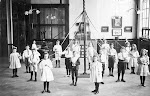
Picture taken from Cornell University's Home Economics Archive.

Well, it's times like this I wish I had a scanner. The Woman's Book, which does indeed "Contain Everything a Woman Ought to Know", has some wonderful illustrations of Edwardian women, resplendent in bluestockings and bloomers, exercising to improve both their health and vitality, just like their American counterparts in the picture I nabbed from Cornell University! There are also detailed pictures on home milinary, canary breeding cages, linen cupboards, French hairstyles, plain sewing, carving instructions, carpet sweepers and those new-fangled gas stoves. Indeed, The Woman's Book is such a comprehensive guide to middle-class, female, Edwardian existence that I could only do it justice, examining it in detail and placing it within a proper social and historical framework, by writing a thesis on it! This would I feel make for very boring blog fare, so I'm going to do my best to precis its importance and its interesting bits, for your delectation, gentle reader.

First, the book is the product of a remarkable and little know home economist, Florence B Jack. Jack was the principal of the School of Domestic Arts in Edinburgh and later went on to be director (I think, I shall find her exact title out asap) of the British Good Housekeeping Institute. She published many articles in Good Housekeeping magazine between the wars and a wide range of practical cook books including The Good Housekeeping Cook Book, which you can still find for pennies. The Woman's Book, first published in 1911, is however her magnum opus, consisting of chapters on cooking, household management, household finance, health and fitness, child rearing, dressmaking, nursing, gardening, travel, pets, poultry and beekeeping. This list is in no way representative of the book's contents. Think of your own lives, and all of the knowledge you have and the things you have achieved, then imagine cramming this information into a single book, this is what Jack has attempted, and it is no mean feet.

However, it is not simply the comprehensive nature of this book which makes it highly desirable to collectors. Like Beeton it is an effective window into the hopes and aspirations of middle class women at a rather interesting period of time. Just as Beeton charted the rise of the class conscious suburbanites of industrialised, Victorian, Britain, Jack has shown us the cusp of a new moral age. An age in which women will experience an unprecedented amount of freedom, an age where empire and class divisions begin to crumble. So whereas Beaton accepts that a servant workforce will be cheap and plentiful for those householders lucky enough to afford it, Jack talks about the servant problem, young girls preferring factory work to the work of parlour or kitchen maid. She advises women to treat their servants fairly, giving them warm rooms and days off, not just in the spirit of generosity, but in the spirit of pragmatism. We see new kitchen and household appliances appear in order to save the mistress, who has fewer servants and a large home, time and energy. We also see her encourage women to do hands on work for themselves, to acquire the necessary knowledge on household matters, to encourage her servants but also in preparation for those times when she may have few or no servants to help in the home.

However, it is in the very final chapter of the book where we see the book's true collectibility. My own interest is in home economics and homemaking, as many of you know, but other women collect the book because it is the very first housekeeping manual to include chapter on girls' education, careers for women and more importantly women's suffrage. And on these points Jack does not pull her punches. She goes into great detail on how women should train their daughters not just for a life in the home, but for a life in the workforce. For her it is a matter of expediency; not every women will marry, not every woman will bear children, therefore single and widowed women have the right to lead full and useful lives without the taint of dependent Victorian spinsterhood/widowhood. She also details ways in which a married woman can earn extra income whilst still managing a home; a typing service, making sweets and bon-bons (giving good recipes too!), journalism, writing and beekeeping. Moreover, she lists the universities that will offer full degrees to women (all of the red bricks, but none of the Oxbridge colleges as yet) and the universities which will offer medical training for women. She goes into great detail on the training of nurses and teachers and says the creative women may enjoy work in the new hair dressing salons which are popping up all over the country! And finally, she says this:

The question of women's rights is one of the most passionate questions of social reform of our day. The character of the women who are leading the movement. the determined way in which the arguments are being fought out, the great impression produced in Parliament, and the deep and almost unexpected response which the cry of revolt has produced throughout the masses of women of the country, all go to prove that this is a question that must be seriously faced and dealt with.

Women, like men, have a desire to expand their realm of intelligence, to take part in the affairs of the world, which bear upon their lives, and the restraint and force of mere tradition, prejudice, or caste, have become intolerable to them. Women want freer lives because they want freer development; they want more capable minds and increased capacities for grappling with the increased difficulties of modern civilisation...

She then goes on to list the names and addresses of the influential women's suffrage movements of the day, including the Pankhurst women, Mrs Henry Fawcett and Lady Frances Balfour. And, as a modern reader, I can't help but think of the no-nonsense and radical nature of these additions to the book. That is to say, "Everything a Woman Ought to Know" now included how to become educated and how to take a full and complete part in the politics of your nation, as citizens, rather than as dependents.

However, Jack's call for women to "take part in the affairs of the world" is balanced with her obvious fascination and joy she felt for the domestic sphere. For her, domesticity was a paid occupation, for the majority of women she trained and wrote for, domesticity was an unpaid vocation and she wanted them to do it well and enjoy it. The immense detail within the book is perhaps testimony to her love of women's achievements, both within the home and out of it. She writes eloquently about motherhood and good nutrition, in detail on how a woman can save money by running up her own frocks, how sound financial management can make or break a happy home, how a housewife's first duty is to be cheerful and loving and how you can successfully dye a straw boater. For her a woman's sphere was large and ever expanding, women were the receptacles of a practical and spiritual knowledge vital to the proper function of society, but she could also see a time when women's knowledge could be expanded further to matters of politics, academia and the running of an effective beauty salon! I shall leave you now with a few inspirational quotations to help you on your merry way. Enjoy!

We as a nation are very much behindhand with our cooking arrangements, and it is only now that we are beginning to realise that training in the subject should form an important branch of every girl's education.

It is Hammerton who says that "Intellectual labour is in its origin as dependent upon the art of cookery as the dissemination of its results is dependent upon paper-making and printing. Cookery in its perfection - the great science of preparing food in the best way suited to our use - is really the most important of all sciences and the mother of the arts."

A woman should cherish her health as her most valued possession, for good health is assuredly as potent a factor in promoting her happiness as ill-health is in destroying it...The healthy woman, by very reason of her vitality, permeates cheerfulness and happiness around her.